

What Replaces Credentials in a Changing Nonprofit Market?
Why credentials alone don’t convert into opportunities, and what does

Shifting focus from traditional achievements to actionable, problem-solving capability.
For many years, the nonprofit sector ran on a reliable formula: obtain a degree/certification, a few years at a recognizable organization, and a steady climb up the title ladder.
That pathway worked for many. It signaled readiness and credibility.
Now, the formula is breaking.
62 percent of nonprofit professionals report being overqualified for the roles available—caught between entry-level positions they've outgrown and senior roles that demand narrower specialization than their broad experience provides.
According to the 2026 Social Impact Staff Retention report, 70% of nonprofit professionals are considering leaving their jobs. Nonprofits now face tighter funding, greater demand for measurable outcomes, and pressure to move quickly. In this environment, they hire for demonstrated problem-solving ability, not just paper qualifications.
You can have credentials on paper and still be unclear in the market, waiting months for your next opportunity.
What's Changing
This shift doesn't announce itself. It shows up in small ways:
Roles that feel harder to define
Conversations that go well but don't convert
Opportunities that almost materialize, then stall out
Organizations are placing more weight on skills and demonstrated capability than on formal background. The question becomes: can you solve this problem?
Credentials are not irrelevant. They are no longer the deciding factor.
It’s now about translating your experience into the language the market uses to buy solutions. That’s difficult when you’re turning intangible skills and services into tangible outcomes.
What "Skills-Based" Actually Means
Skills-based hiring prioritizes what someone can do over where they’ve worked or what degrees they hold.
It doesn't mean replacing credentials with a checklist of tasks. Instead, it asks whether someone can:
Define a problem clearly
Make decisions in uncertain situations
Guide work toward an outcome
These are not signals that a title or degree can fully capture. They are built through repeated exposure to real problems.
The Credential Paradox
Most professionals don’t realize the shift is happening.
Conversations go well. Interviews feel positive. References are strong, but offers don’t materialize.
You describe your value using credentials. The market evaluates you based on problem-solving ability.
Nothing feels obviously wrong, but opportunities stall at the pricing stage because the work hasn’t been defined clearly enough for the market to value it.
The Other Side of the Problem
This mismatch is not only on the professional side. Organizations often do not define their problems clearly either.
Opportunities are described as:
"Strategic planning support."
"Organizational capacity building."
"Help with board governance."
These are categories, not problems. When the problem is unclear, the work cannot be scoped, priced, or delivered well.
This is where most misalignment happens.
The organization believes they are asking for one thing. You believe you are delivering another. The gap shows up weeks later, when it is harder to fix.
Execution isn’t the problem when the request itself is unclear. Instead of pointing out that something is vague, the work starts with better questions:
What situation prompted this request?
What would change if this work goes well?
Who needs to be aligned for this to succeed?
If an organization can’t answer what problem needs solving, what outcome defines success, and who makes the decision, the opportunity may not be ready to be scoped or priced.
These questions do more than clarify scope. They turn a vague category into a defined problem that you and the organization can value.
Why This Matters for Independent Work
If you’re considering independent work, this gap becomes unavoidable. Inside an organization, credentials can carry weight. Outside, they don’t always translate into revenue on their own.
What actually converts is:
The problem you solve
How you approach it
What outcome do you produce
The question shifts from “What am I qualified to do?” to “What do people consistently need help with and will pay for?”
Workforce research points to the importance of continuous skill development, adaptability, and judgment. These only matter when they are connected to a clear problem.
Three Questions Worth Asking
Before making a move toward independent work, test whether your experience translates into market value.
Answer these three questions:
1. What problem do you solve consistently?
Not your job title. What do people consistently ask you to fix, clarify, or stabilize?
2. What skill do you possess that a machine does not?
Tasks are becoming easier to automate. What remains valuable is judgment—how you interpret, decide, and guide.
3. What outcome do you produce that someone would pay for?
If you cannot name the outcome, you cannot price the work. If you cannot price the work, everything else becomes unclear.
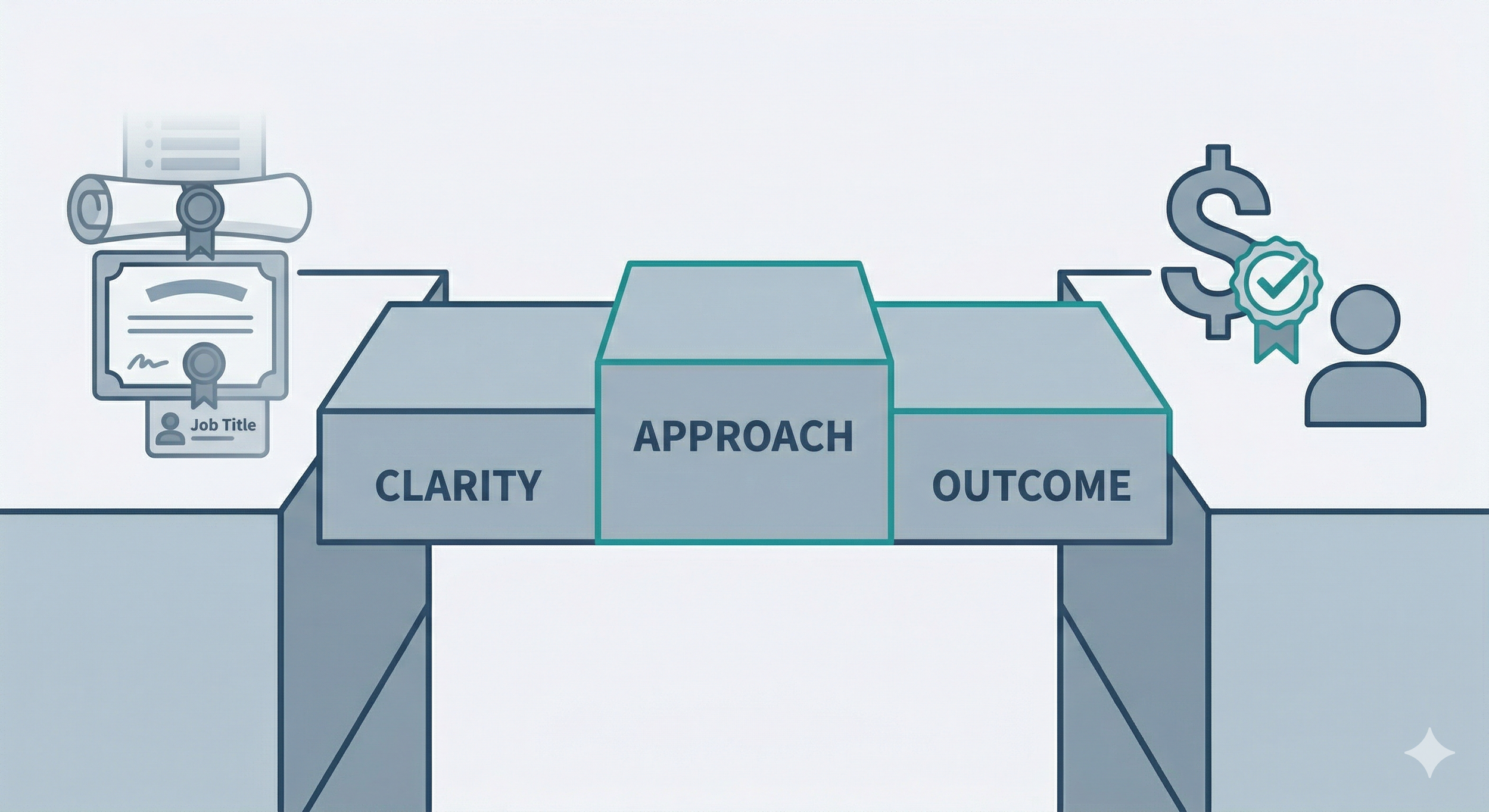
A structural pathway converting abstract professional credentials into defined, tangible market value.
Credentials and experience still have significant value, but the market is signaling that it now rewards problem‑solving over credentials alone.
For independent work, the path forward is describing your work in terms the market uses:
problem → approach → outcome.
Most people do not see the gap until they try to price their work. That’s usually when things either become clear or fall apart.
A Practical Next Step
If you are considering independent work, the challenge is not gathering more information. It is understanding whether your work holds up when you put numbers to it.
I built a simple pricing guide to help you translate your experience into a sustainable financial baseline. It shows what your work needs to support based on the math, not what feels reasonable. Try the pricing guide →Here
