

Why Traditional Nonprofit Staffing Models Are Under Strain
How funding realities, role expansion, and workforce expectations are reshaping nonprofit employment.

Illustration of a traditional organizational pyramid with subtle cracks suggesting structural strain.
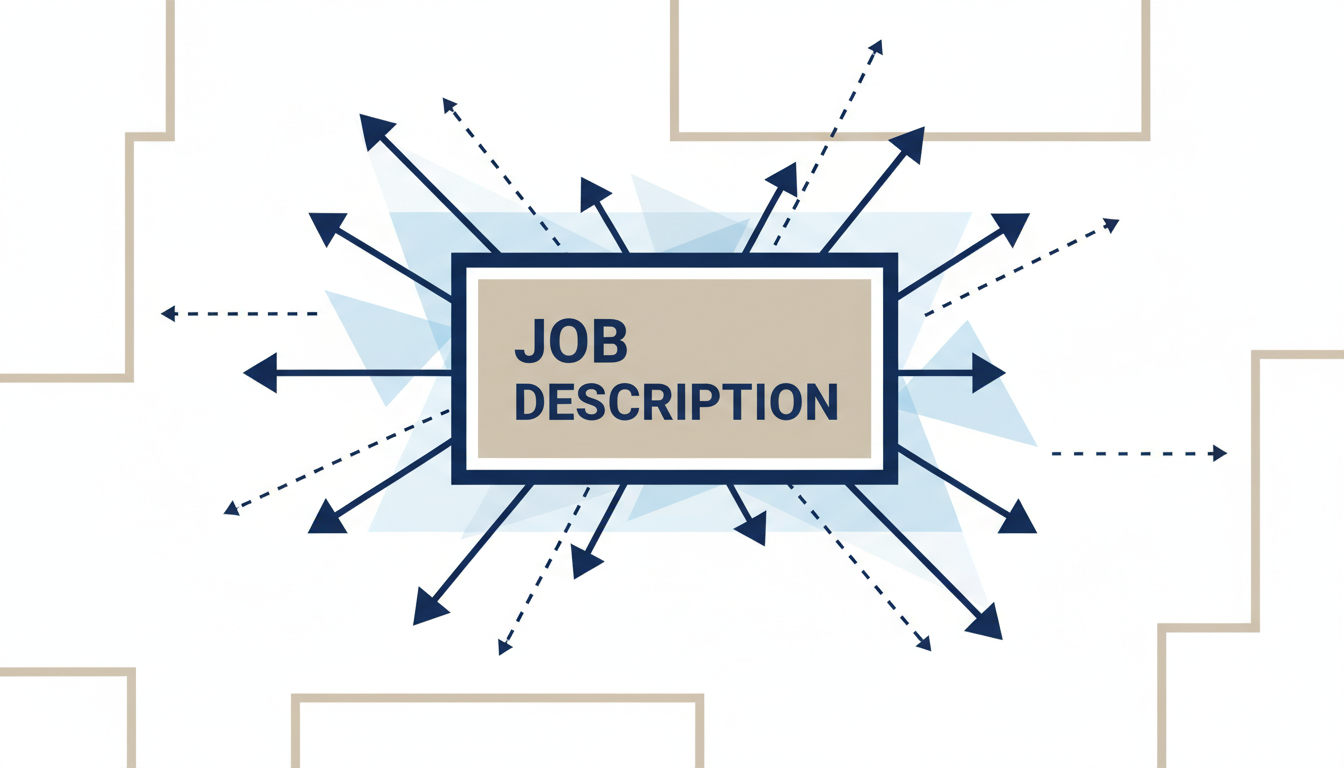
Job descriptions inside nonprofits often appear to describe one role.
The actual work often requires three or more.
Program managers handle programming, grant writing, communications, board coordination, and crisis response. Titles stay the same. Compensation often does not.
Consider a typical mid-level leadership posting: coalition management, strategic design, communications oversight, governance facilitation, data evaluation, and field-building. The salary offered may be $70,000–$75,000. In many cities where rents have risen sharply, that range falls below what financial planners consider sustainable for a single-person household, let alone someone supporting a family or managing childcare costs.
This is not about one organization. It reflects a broader pattern. Nonprofits often need multiple forms of expertise, but can fund only one generalist salary.
That pattern reflects a staffing model built for predictable revenue and clearly bounded responsibilities. Many nonprofits operate with neither.
This matters whether you are leading a nonprofit or reconsidering your role inside one.
Before continuing, consider your own situation.
If you are a nonprofit leader, ask:
Does this job description describe one role or several? Which responsibilities create the most strain?
If you are a nonprofit professional, ask:
How many jobs are compressed into my current role? Is this salary sustainable where I live?
The analysis that follows may help explain the patterns you are already sensing.
How We Got Here
For decades, many nonprofits were structured around predictable grant cycles, stable donor bases, and clearly defined internal roles. Full-time employment with defined responsibilities, supplemented by volunteer workers and part-time staff, made sense within that environment.
Over time, funding cycles shortened, reporting requirements increased, and technology expanded what a single role could manage. Compensation structures, however, did not expand at the same pace.
The staffing model remained largely intact while the operating conditions around it changed.
What Traditional Nonprofit Employment Assumes
The standard nonprofit employment model relies on full-time W-2 staff with defined roles and employer-provided benefits.
It assumes:
Predictable revenue
Clear role boundaries
Long-term planning capacity
Yet many organizations depend on restricted grants, short funding cycles, and uncertain renewals.
Full-time employment assumes financial stability. Funding models often do not provide it.
That mismatch creates pressure.
Three Forces Increasing Staffing Pressure
1. Limited Cash Reserves
More than half of nonprofits report three months or less of cash on hand.
That margin is too thin to sustain full-time payroll through funding delays or grant shifts. When reserves are low, hiring freezes and unfilled positions follow. The work doesn't disappear. It gets absorbed by existing staff.
Maintaining full-time payroll requires predictability. Many organizations operate without it.
2. Expanding Roles Without Adjustment
When budgets tighten, roles expand.
Organizations hire for one position but expect fundraising, reporting, partnership management, and operational support. In larger institutions, these would be separate jobs.
This is not about weak leadership. It reflects constrained capacity.
3. Changing Workforce Expectations
Flexibility and autonomy are no longer perks. They are baseline expectations.
A strong majority of workers now prioritize flexibility when evaluating employment.
Full-time, always-available expectations increasingly conflict with workforce priorities.
Why Burnout and Turnover Follow
When responsibility expands but compensation and authority do not, strain accumulates.
Burnout is often framed as a personal issue.
In many cases, it reflects workload exceeding financial and operational capacity.
Turnover compounds the problem. Recruitment costs increase. Institutional knowledge is lost. Relationships reset. The cycle continues.
Sustainability is not determined by commitment or effort. It is determined by whether funding, workload, compensation, and authority are aligned. When they fall out of alignment, burnout and turnover are not personal failures. They are predictable outcomes.
When this pattern repeats across the sector, the consequences compound. Experienced professionals exit mid-career, often at the peak of their effectiveness. Leadership pipelines thin. Institutional knowledge disperses. Remaining staff absorb more responsibility without additional capacity. Fundraising and compliance demands increase, but bandwidth does not. Mission delivery becomes reactive rather than strategic, not because of individual failure, but because the model cannot sustain what it requires.
Why this matters is straightforward. Organizations lose the capacity to serve their missions effectively. The work continues, but the people doing it keep changing. Programs that depend on relationships, institutional knowledge, and continuity suffer most.
What Is Emerging in Response

Illustration showing a rigid organizational structure transitioning into a flexible modular model.
Across the broader U.S. labor market, independent and contract work has grown steadily over the past decade. At the same time, many mission-driven organizations increasingly rely on consultants, fractional leaders, and project-based specialists to fill capacity gaps.
Within nonprofits, this often looks like:
Retaining fractional CFOs for forecasting and board reporting
Contracting specialized grant writers during funding cycles
Engaging part-time HR consultants
Bringing in project-based operations support
For example, an organization might retain a fractional CFO for 15 hours per month to manage cash flow projections and board reporting while maintaining a full-time bookkeeper for daily transactions. The fractional role participates in leadership meetings and decision-making, not just accounting tasks. That integration makes the arrangement strategic rather than temporary.
A community health nonprofit might contract a grant writer for three months during a federal funding cycle rather than carrying an unfilled development position year-round.
This is not simply a cost decision. It reflects an attempt to align how work is organized with funding volatility and specialized expertise. The growth of fractional and project-based roles is a response to constrained capacity and financial unpredictability.
Independent professionals are already part of nonprofit operations. The question is how intentionally they are integrated. Without clear integration, patchwork staffing creates coordination gaps, unclear accountability, and additional strain on remaining full-time staff who must bridge the disconnects.
The Decision Organizations and Professionals Are Facing
Organizations are not choosing between full-time staff and contractors in theory. They are asking:
Can we sustain this role if funding shifts?
Are we hiring for defined work or hoping someone absorbs uncertainty?
Would specialized part-time expertise better serve the mission than one expanded generalist role?
For nonprofit professionals, especially those quietly reconsidering their role or exploring independent work, the questions are sharper:
Is this job description asking for one job or several?
Is the compensation aligned with the scope and cost of living?
Am I being hired to solve a clear problem, or to carry unresolved ambiguity?
Some professionals are not burned out from mission work. They are stretched thin across undefined or unrealistic expectations.
Naming that difference matters.
What This Means Going Forward
Traditional full-time employment is not disappearing.
Organizations are being pushed to align role design with funding and technological realities.
The shift is already underway. The question is whether it unfolds through intentional redesign or through continued attrition and reactive adjustments.
As organizations recalibrate how they structure work, professionals will make parallel decisions about how they participate in it. The traditional full-time model remains one path. It is no longer the only one.
Editor’s Note
This piece examines forces creating strain in nonprofit staffing models. It is not an argument against full-time employment but an analysis of why traditional models are increasingly difficult to sustain.
Author Bio
Jeff Tripp works with nonprofit professionals navigating the shift between employment and independent work. He helps people clarify baseline revenue needs, pricing structure, and role boundaries before making commitments they can't sustain. He is the creator of Meso.
